Formulation Optimization of a Water-Based Adhesive for Medical Plasters Using Simplex Lattice Design
DOI:
https://doi.org/10.33479/jfmc.v4i2.218Keywords:
adhesive performance, medical plasters, mixture optimization, polybutene, water-based adhesivesAbstract
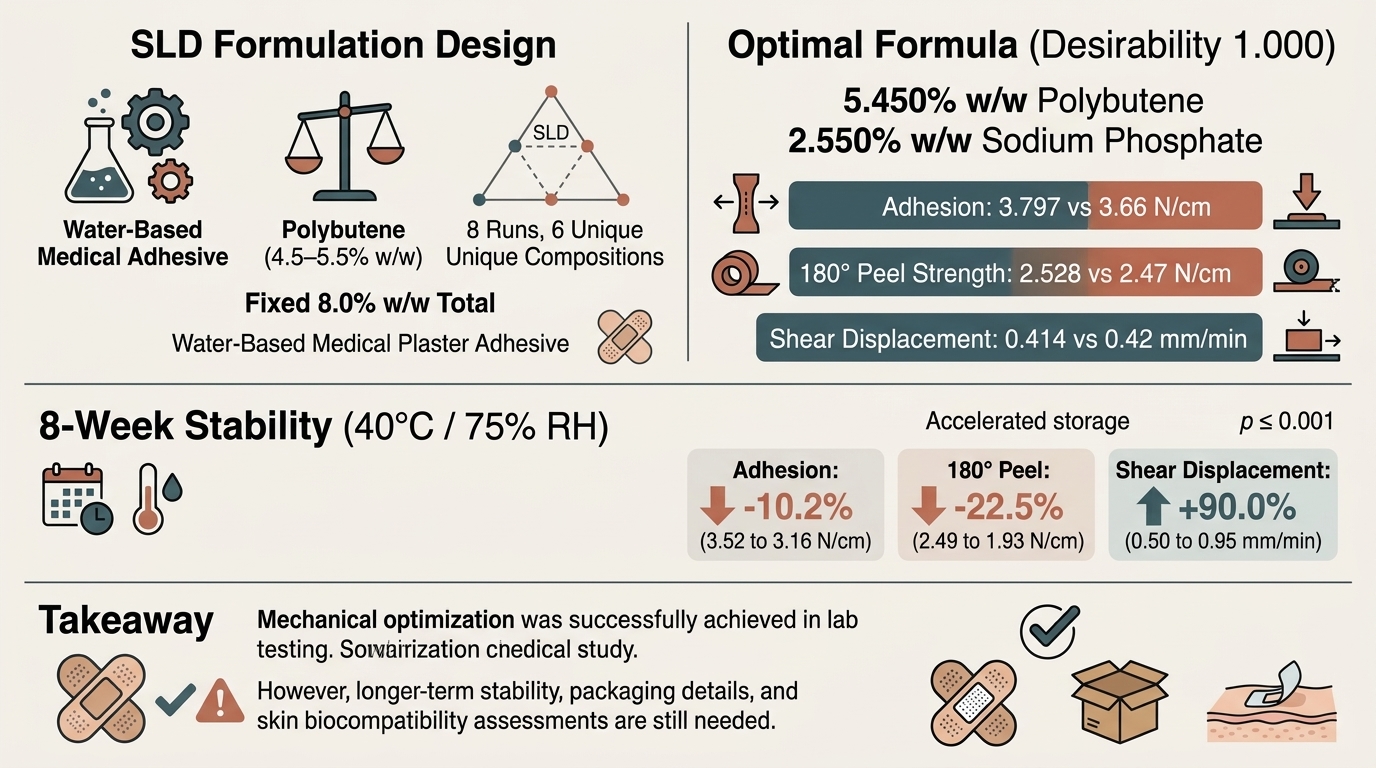
Pressure-sensitive adhesives for medical plasters must balance interfacial adhesion with cohesive resistance. This study optimized a water-based adhesive by varying polybutene and sodium phosphate using a two-component Simplex Lattice Design (SLD). Eight experimental runs comprising six unique mixture compositions were evaluated for appearance, pH, homogeneity, viscosity, adhesion, 180° peel strength, and shear displacement rate. Multiresponse optimization selected a composition containing 5.450% w/w polybutene and 2.550% w/w sodium phosphate (desirability = 1.000). Model predictions were 3.797 N/cm for adhesion, 2.528 N/cm for peel strength, and 0.414 mm/min for shear displacement; confirmation testing yielded 3.66 ± 0.14 N/cm, 2.47 ± 0.06 N/cm, and 0.42 ± 0.03 mm/min, respectively. During eight weeks of accelerated storage at 40 °C/75% RH, adhesion decreased by 10.2% (3.52 to 3.16 N/cm), peel strength decreased by 22.5% (2.49 to 1.93 N/cm), and shear displacement increased by 90.0% (0.50 to 0.95 mm/min). One-way ANOVA indicated time-related differences in all three responses (p ≤ 0.001); however, replicate independence and packaging configuration were not documented. These results identify a composition that met the specified model-based optimization goals within the studied design space, but do not establish shelf life or clinical suitability. Further testing over longer periods, with documented packaging, independent batches, and skin biocompatibility assessment, is required.
Downloads
Published
How to Cite
Issue
Section
License
Copyright (c) 2026 Endra Atmajaya, Yudi , Lina

This work is licensed under a Creative Commons Attribution-ShareAlike 4.0 International License.