Cost-Effectiveness of Sodium Hyaluronate versus Carboxymethylcellulose in Patients with Dry Eye Disease Following Cataract Surgery
DOI:
https://doi.org/10.33479/jfmc.v4i2.190Keywords:
Cost effectiveness, Dry Eye Syndrome, ICERAbstract
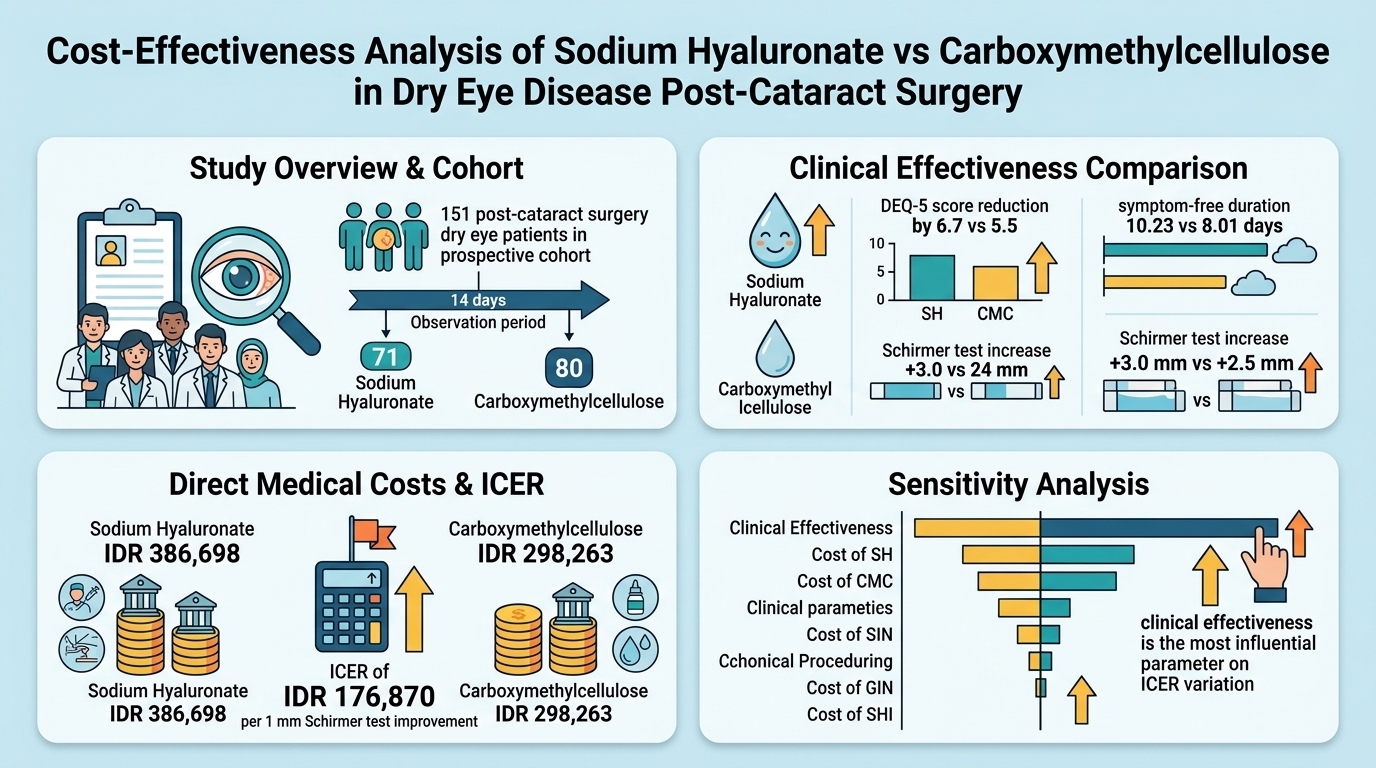
Dry eye disease is a common complication after cataract surgery and often requires artificial tear therapy to alleviate symptoms and improve tear film function. This study aimed to analyse the cost-effectiveness of sodium hyaluronate and carboxymethylcellulose in patients with dry eye following cataract surgery. This study provides clinical and economic evidence to support the selection of effective and efficient artificial tear therapy. A prospective cohort analytical observational design with a Cost-Effectiveness Analysis (CEA) approach was conducted from the healthcare provider perspective. The observation period was 14 days. A total of 151 patients met the inclusion criteria, comprising 71 patients receiving sodium hyaluronate and 80 receiving carboxymethylcellulose. Cost-effectiveness was evaluated using the average cost-effectiveness ratio (ACER), incremental cost-effectiveness ratio (ICER), and one-way sensitivity analysis, with the Schirmer test as the main effectiveness parameter. Sodium hyaluronate demonstrated greater effectiveness than carboxymethylcellulose, with a reduction of 6.7 points in DEQ-5 score, a symptom-free duration of 10.23 days, and an increase of 3.0 mm in Schirmer test values. Based on the Schirmer test, the ACER was IDR 119,305 for carboxymethylcellulose and IDR 128,900 for sodium hyaluronate. The ICER showed that sodium hyaluronate required an additional cost of IDR 176,870 to obtain one additional 1 mm improvement in Schirmer test value compared with carboxymethylcellulose. One-way sensitivity analysis showed that changes in effectiveness had a greater influence on the ICER than changes in cost. Sodium hyaluronate therefore provided greater effectiveness but required higher costs than carboxymethylcellulose.
Downloads
Published
How to Cite
Issue
Section
License
Copyright (c) 2026 Rodhi Anshari, Tri Murti Andayani, Jason Merari Peranginangin

This work is licensed under a Creative Commons Attribution-ShareAlike 4.0 International License.