Association of Vitamin B6 Administration with Adverse Events of Antituberculosis Drugs in Drug-Resistant Tuberculosis Patients
DOI:
https://doi.org/10.33479/jfmc.v4i2.217Keywords:
Adverse drug events, Drug-resistant tuberculosis, Linezolid, Pyridoxine, Vitamin B6Abstract
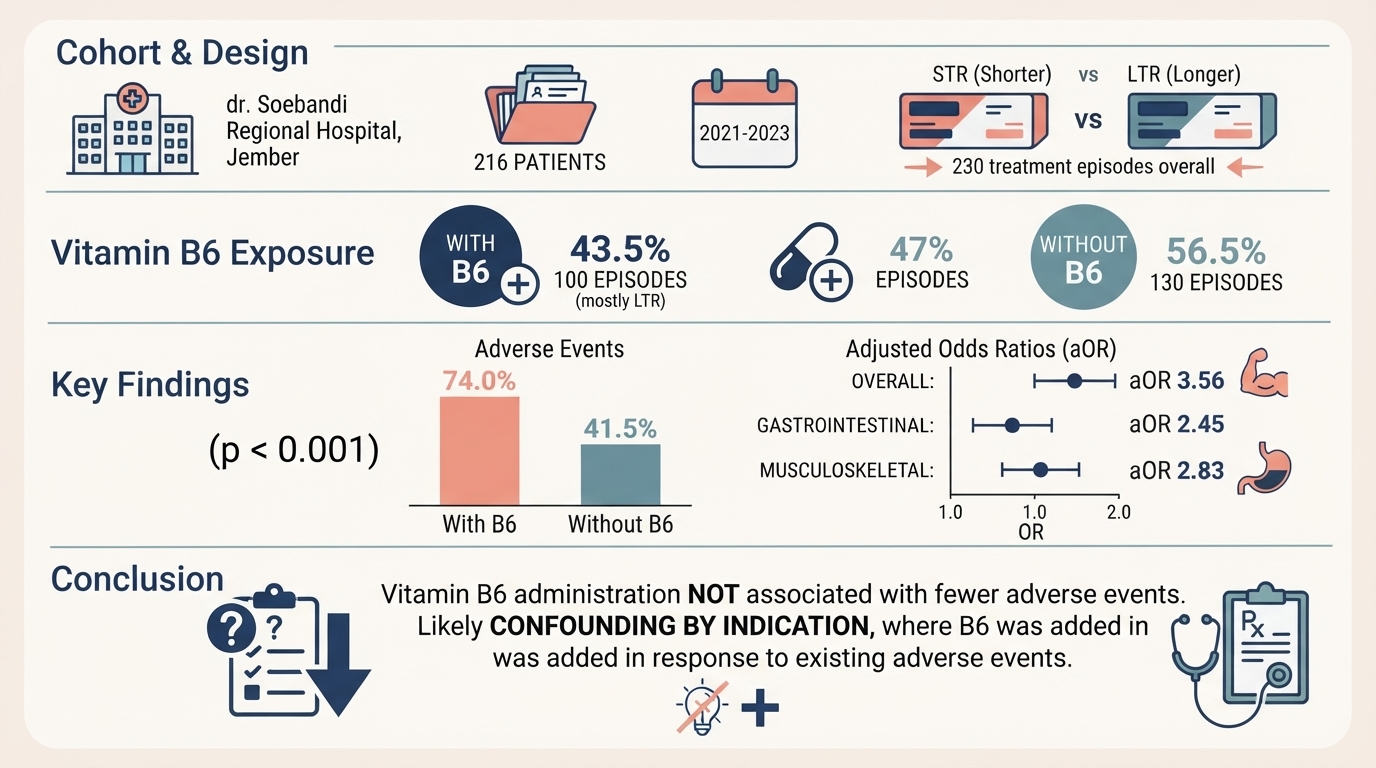
Vitamin B6 (pyridoxine) is routinely co-administered with second-line antituberculosis drugs to prevent neurotoxicity, but its benefit in injection-free regimens for drug-resistant tuberculosis (DR-TB) remains unclear. This study aimed to analyze the association between vitamin B6 administration and the occurrence of antituberculosis drug adverse events in patients with MDR/RR-TB. A retrospective cohort study was conducted on 230 treatment episodes of the shorter treatment regimen (STR) and the longer treatment regimen (LTR) among 216 patients at dr. Soebandi Regional Hospital, Jember, in 2021–2023. Data were analyzed using chi-square/Fisher tests, Mantel-Haenszel stratification, binary logistic regression, and generalized estimating equations (GEE). Vitamin B6 was given in 100 episodes (43.5%), mainly with the LTR (66.7% vs. 8.7% with the STR). Adverse events occurred in 74.0% of episodes with B6 and in 41.5% of episodes without it (p < 0.001). After adjustment for regimen, age, and sex, B6 administration remained associated with any adverse event (aOR 3.56; 95% CI 1.79–7.07), gastrointestinal events (aOR 2.45; 1.26–4.78), and musculoskeletal events (aOR 2.83; 1.31–6.09), but not with skin events. Similar results were obtained in the LTR-only and GEE analyses. Vitamin B6 administration was not associated with fewer antituberculosis drug adverse events. The positive association observed likely reflects confounding by indication because the timing of B6 administration was not recorded; prospective studies recording the start date, dose, and reason for B6 administration are therefore needed
Downloads
Published
How to Cite
Issue
Section
License
Copyright (c) 2026 Neny Poerwahyuningrum, Shinta Mayasari, Dewi Rashati, Ayu Angger Putri M. Soleh

This work is licensed under a Creative Commons Attribution-ShareAlike 4.0 International License.