Antibacterial Activity Test Of Facial Serum Formulation Of Pegagan Leaf Extract (Centella asiatica L.) And Pandan Leaf Extract (Pandanus amaryllifolius R.) Against Cutibacterium acnes Bacteria
DOI:
https://doi.org/10.33479/jfmc.v4i2.176Keywords:
Antibacterial, Cutibacterium acnes, Centella asiatica L., Facial Serum, Pandanus amaryllifolius RAbstract
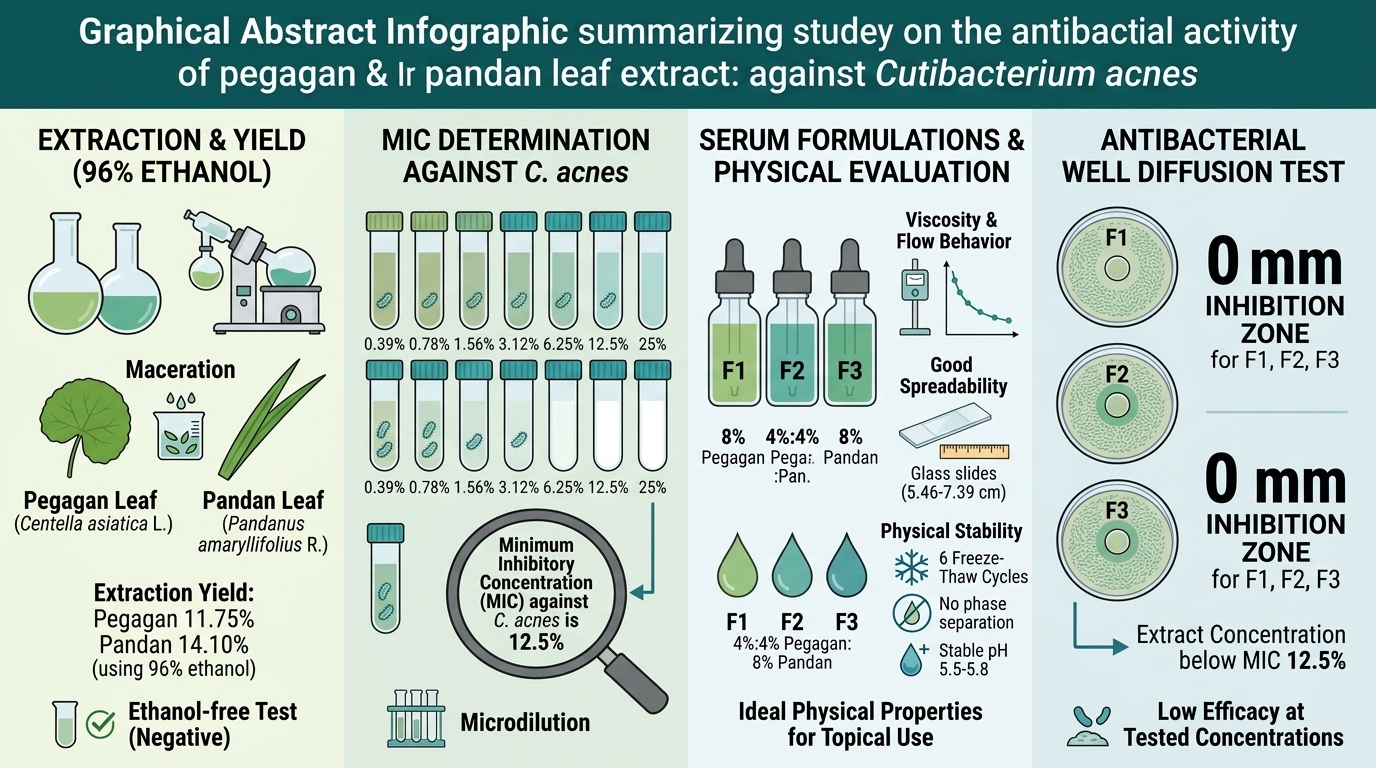
This study aimed to evaluate the physical quality and antibacterial activity of facial serum formulations combining pegagan and pandan leaf extracts. Extraction was performed using maceration with 96% ethanol, yielding 11.75% for pegagan and 14.10% for pandan. The Minimum Inhibitory Concentration (MIC) of pegagan extract against Cutibacterium acnes was 12.5%. Serum formulations consisted of F1 (8% pegagan), F2 (4%:4% combination), and F3 (8% pandan). Physical evaluation showed that all formulations were homogeneous with a slightly viscous liquid consistency. Viscosities were F1 (573.33 cP), F2 (612.00 cP), and F3 (436.00 cP), all fulfilling the requirements with pseudoplastic flow behavior. Spreadability values for F1 (6.00 cm) and F2 (5.46 cm) met the good category criteria, while F3 (7.39 cm) exceeded the standard. Preparations remained stable through 6 freeze-thaw cycles without organoleptic changes, and pH values remained consistent within the range of 5.496–5.847. Well diffusion tests showed that facial serum formulations F1, F2, and F3 did not produce any inhibition zone diameter (0 mm) because the extract concentration in the preparations was below the Minimum Inhibitory Concentration (MIC). The combination facial serum demonstrated good physical stability but had not yet provided inhibitory activity against Cutibacterium acnes bacteria at these concentration levels.
Downloads
Published
How to Cite
Issue
Section
License
Copyright (c) 2026 Thoby Tri Jayana, Devilke Yandriyani, Eva Monica

This work is licensed under a Creative Commons Attribution-ShareAlike 4.0 International License.